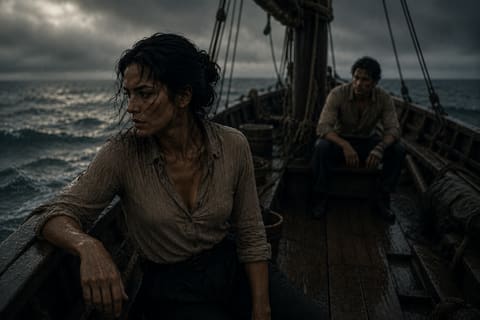
Part 1
Nobody on the ridge moved for him.
Corren walked through anyway — past lines of Marans passing broken stone hand to hand, organized, wordless, their rhythm older than his authority and indifferent to its collapse. A woman carrying a timber brace shifted half a step without looking. Road-courtesy. The kind you extend to a stray dog that hasn’t bitten anyone yet.
His remaining officers waited at the eastern settlement with a villager’s boat — broad-beamed, reeking of fish oil, secured only because the requisitioned launch was ash on the waterline and every skiff in the southern harbor lay crushed under the cliff. A tender. Nothing more. The Bureau transport vessel sat at anchor beyond the headland, too deep-drafted for the shallows, unreachable until now.
His men loaded the transit case first. He watched them handle it with the careful blankness of men whose careers depended on the sealed summary inside: document unrecovered, operative defected, assessment terminated under emergency protocol. They did not ask questions. They had learned that from him.
The villager rowed them out in silence.
The transport vessel’s hull rose above them. His men secured the ladder. Lateral reassignment waited in the sealed summary’s routing. Not punitive. The institution did not punish failure — it dissolved failure into mass, redistributed the weight until no single body bore enough to break.
He had never read requisition series 471 for content. Knew its classification, its routing history, its archive chain. Knew what it cost to lose it. Had never once asked what it said.
Something in his chest — small, angular, like a stone swallowed wrong — wanted him to ask now.
He climbed the ladder instead.
Part 2
“Your framework gave him the island, Lyra.”
Torath’s voice hit the basalt table before she’d taken her chair. Six seats filled, six faces turned — the full body, convened without her asking.
“Eleven exchanges in your name.” His jaw worked. “Your remediation clause. Corren used it to seize emergency jurisdiction over every soul on this rock.”
Sera spoke from his left. “Her framework also produced the vote that broke his authority. Three-three. My voice among them.” She did not look at Lyra. “The tool cut both ways.”
Pellar’s hands were flat on the table, pressed white at the fingertips. He said nothing. The youngest member watched the fracture run through the room exactly where it had run in the last session: Torath’s bloc against Sera’s, with Pellar on the crack.
Lyra did not defend.
“Fourteen families have no shelter.” No appeal — inventory. “The accusation stands. I will answer it. But not before the displaced are under roof.”
Silence. The Maran kind — exhaustion finding its footing.
“Harbor coordination,” Torath said. No warmth.
“I’ll take it.”
“You will.” He held her gaze across the table. “And when the rock is moved, we sit again.”
His cousin — one of the three who had turned the broken-word posture on her — rose without speaking and walked toward the southern rubble line. The others followed in ones and twos, each departure a small verdict: not forgiveness, not condemnation, but the calculation that survival outranks judgment until the surviving is done.
Lyra stood last in the empty chamber, the accusation unspoken behind her and the harbor’s dead weight waiting ahead.
Part 3
Dak saw it first.
A shape on the horizon astern, hull-down, holding their heading. He said nothing. He adjusted the tiller two degrees east and watched. Ren climbed the mast step and stayed there, one hand on the stay, her jaw scrape dark against the morning light.
Kae stood at the gunwale with the document bound against her ribs and counted her own heartbeats. Vess stood behind her, left hand cradled against his chest, his one open eye fixed on the same point she watched.
An hour. The shape held. Dak trimmed the sail until the pitch-darkened hull heeled and spray broke across the bow. Ren called distances — three miles, still three, now four. The shape was turning. A trading brig, broad-beamed, indifferent, falling south toward whatever port wanted its cargo more than it wanted theirs.
Maret opened her eyes. Dak’s shoulders dropped half an inch. No one spoke. The relief was worse than the fear — it confirmed the fear had been correct.
That night the ocean flattened to black glass. Kae sat against the transom. Vess lowered himself beside her, ribs audible in every breath, and said the first name.
Tessavar. He’d assessed it three years ago. Viability negative. Population relocated to a Hurshi client settlement. He said it the way his ledger held numbers — clean, unweighted, bled of everything that made the word a place where people had lived and raised children and salted fish for winter.
Then the next island. Then the next. Each one stripped to the same three terms: assessed, negative, relocated. The wall. She recognized it. She’d built her own from survey data and steady hands.
She said nothing. She let him use the numbers. He needed them to reach whatever waited behind them, and she could feel it gathering in the silence between each island’s name — the thing the wall was built to hold.
Part 4
Fifth night, and Vess said her father’s name.
Not the surname on the chart header — the full name that had crossed his desk in a restricted Bureau file three years into his posting. A routine archive audit. A classification gap in the requisition series. Vess flagged it.
He told her this with his hands open on his knees, palms up, as though holding something he was about to set down.
His flag initiated a recovery operation. A civilian on Mara had obtained a classified remediation document — requisition series 471. The file did not say how. The Bureau dispatched a four-person team. He did not know, then, what the document contained. He knew only that it was missing and that his signature had started the sequence.
Kae’s breathing changed. He heard it. He kept going.
The team reached Mara. The civilian ran — south along the eastern escarpment, the section she had surveyed at Station 14, the cliff where she’d hung her father’s plumb line over the edge and measured the absence he’d left behind. Four went after him. One came back carrying a document. The rest came back carrying a story.
The closure report read accidental death, unstable terrain. Her father had walked that rock in darkness and fog for decades. He knew every handhold. The Bureau’s own data said the ground held. It held for another eleven years before it took the southern harbor and seven people with it.
Vess signed the closure report. Filed it. Did not question it — not until her surname appeared on a chart header and his thumb went white against the page.
He stopped talking.
The sound that left Kae’s chest was not a word. It came from behind the sternum, struck from bone — once — and carried across the water like something that would not come back.
She pulled her shoulder from his. The night air filled the space where contact had been.
Part 5
Nowhere on this boat was far enough.
Kae’s knees found the hull planking forward of the mast step. She pressed both palms flat against the wood the way Dak pressed them to stone — not seeking, not reading, just holding on to something that wasn’t a person. The grain buzzed under her skin. Ocean transmitted through pine. The vibration asked nothing of her.
The document lay bound against her ribs. Her father’s survey strap held it there — the same strap he’d used to carry his plumb line, his field notes, the measurements that filled the Bureau’s own data gaps. The same document he’d died trying to bring home. An earlier version. Partial. Enough to fall from a cliff for.
She knew its path now. Every hand. Her father’s — however he’d gotten it, whatever risk he’d judged worth the taking. The recovery team’s, four of them on Maran soil, logging his death as accidental on terrain their own data called stable. Then Vess’s hands. The archive audit, the flag, the notation that climbed until four people arrived on her island in autumn and her father ran south along a cliff the Bureau had stamped safe.
Then Vess’s hands again, years later. Pulling the full version from the same archive. Wrapping it in oilcloth. Pressing it into her palms in the storm cache and telling her to hide it where he couldn’t know.
She could feel his weight shift the boat behind her. Six feet of salt air. She had chosen to trust the tremor in his hands over every fact she knew about the institution those hands served. She had felt something rearrange behind her sternum when he touched her — and those same hands had written her father’s name into a closure report and moved on to the next file.
The circle was closed. The document had come home to the surveyor’s daughter through the hands of the man who set the machinery in motion. She did not know what to do with the fact that those hands had also held her like something that could break.
Her palms stayed on the wood. The sea moved through the hull, through her wrists, through the bones her father had given her. She breathed. She did not speak. She did not leave.
The strap held.
Part 6
Dessa’s hands said it before her mouth could.
She took the basalt chunk from Lyra and held it a beat too long. Eyes on Lyra’s face. Fourteen families working the collapsed harbor’s edge, hauling rock hand to hand up the slope toward the terrace granaries, and Dessa held the line still with a look that weighed more than the stone.
Lyra took the next piece from the man on her left. Passed it right. Her palms were raw. Everyone’s palms were raw.
“Renegotiation is underway.” She said it loud. She wanted the line to hear — all of them, not just Dessa. No more backroom letters sealed between tariff notices. “Population kept whole. Maran governance preserved as administrative unit. Bureau oversight limited to transport coordination.”
Dessa’s grip tightened. “Why would they agree to any of it?”
Seven dead beneath this rock. Seven names Lyra had recited at the waterline with forty others, faces toward the sea, nobody looking at anyone. She shifted the next stone’s weight through her wrists.
“Because they need this to look voluntary.”
Dessa took the stone. The line kept moving.
After dark, Lyra spread the pages across her kitchen table by candle stub. Copies Kae had made in the cove before departure — the requisition series document reproduced in her daughter’s cramped hand, and beside it, everything Kae had reconstructed from memory of her father’s cross-island annotations. The descending numbers. The station profiles. Written fast, smeared at the margins, by a woman who knew the sea might swallow the originals.
Lyra’s hands stopped over the pages. She could not know what water Kae was crossing. What weather. What reach.
She folded the copies into oilcloth. The sealed envelope from behind the false stone had held one name — a scholar at the Sacred Library her husband had never spoken aloud. Lyra wrote it on the packet and nothing else.
The fishermen’s network would carry it through three islands before it reached a Hurshi port, and by then it would look like a trade manifest.
Part 7
Two days without a word between them.
Dak adjusted. He split the watches so Kae took bow and Vess took stern, the full length of the boat separating what neither could yet bridge. Ren left a water skin at the bow each morning without comment, tucked against the coiled line where Kae sat with her father’s charts spread across her knees. Maret, passing Vess on the mid-deck, caught his eye once — held it — then moved on. No pity in it. Just the plain acknowledgment of grief taking up residence in a space too small to hide it.
The sea ran long and grey. Wind held from the southwest. The hull’s vibration passed through the planking into Kae’s palms where she braced herself, and she let it, the way Dak had taught her — reading what the water carried. Vess sat against the transom with his splinted hand across his lap and his good eye fixed on nothing. The swelling had receded enough to show the shape of his face beneath it. She had studied that face for days before the truth. She studied it now with the truth installed behind every feature.
On the seventh night she turned.
He was already looking. No wall. No flinch. No controlled stillness pretending to be composure. Just the man who had flagged a classification gap in a restricted archive and signed a closure report that called her father’s death accidental and spent three years inside the machine that made the death necessary, becoming — one stolen page at a time — the person who would carry the same document back out.
She extended her hand. Palm up. Open.
Not forgiveness. She did not have that. Permission. To remain. To carry what he carried beside her rather than behind her.
His fingers closed around hers. Careful around the splint. His grip uneven, partial, and deliberate.
Neither spoke.
The boat sailed north. Stars burned through a break in the overcast. Dak’s bare feet shifted on the deck — then stopped.
“Sail.”
Kae followed his gaze astern. A shape on the horizon, pale canvas catching moonlight. Not drifting. Not angled on a trade route. Deep-hulled, full-rigged, holding a direct heading that matched theirs exactly.
Hours behind. Closing.
Part 8
The fog found them before the islands did.
It rolled across the bow in a grey wall that swallowed the horizon and turned the ocean into a disc of black glass fifteen meters wide. Behind them — visible when the fog thinned in gusts — the Bureau vessel’s canvas held its line, closer now than at dawn. Deep-hulled. Built for open water, not channels.
Dak shifted his bare feet on the deck. “Shoals ahead. I can feel the drag.”
Kae pressed her father’s chart flat against the compass housing. Thirty-seven degrees off the winter star. The bearing cut through the scatter of islands emerging from the murk — low dark shapes, treeless ridgelines, rock that looked like it had been dropped rather than grown. She counted seven before the fog ate the eighth.
“Which one?” Vess asked. He stood with his good hand braced against the mast step, weight off his left side.
“I don’t know.”
The bearing pointed. The archipelago offered nothing back — no harbor lights, no smoke, no signal. These islands existed to be passed, not found. The hermit-scholars had chosen them for exactly this quality: terrain that locals marked on charts as empty and left empty.
Dak hauled the tiller. The hull scraped something beneath the waterline — reef or wreck or drowned ridgeline from the old continent — and Ren threw her weight to port as the boat shuddered and cleared. Behind them the Bureau vessel would hit the same shoal chain with three times the draft.
“They’ll anchor and send launches,” Dak said. “Smaller. Faster in the shallows.”
Fog closed. Fog opened. An island resolved dead ahead — steeper than the others, cliff-faced, ringed by a current that pulled the hull sideways before Dak caught it. No beach. No landing. A single fissure in the rock face, wide enough for a boat if the helmsman didn’t breathe.
Kae checked the compass. Thirty-seven degrees exactly.
Behind them, through the last thinning veil of fog, the Bureau vessel dropped anchor and swung out its first launch.