Chapter 6
Part 1
Six guard rotations since the last sounds from the adjacent cell.
Kae tracked them by bootfall — two officers, four-hour shifts, the creak of the door latch at intervals she could set her breath against. She pressed her back to the wall and listened through stone. The first rotation brought muffled questions in Corren’s warm, patient register. Then impact — fist on flesh, the dull report of a body hitting a chair. Then nothing. The second rotation, the same. Questions she couldn’t parse. A sound like a man’s head snapping sideways. Silence.
Always silence.
Three days. Three days and Vess Hurren had given them nothing.
She put her palm flat against the wall. The masonry was cold, salt-damp, and through it she could feel the faintest pulse — not the building, not the guards. The vibration she’d tracked across every station on the island’s perimeter, settled now into the bones of the harbor office itself, patient and low and wrong.
Strategic. Corren’s word. Delivered with a three-second pause calibrated to let her own memory of the doorway fill the silence before the blade dropped. She’d believed it for eleven hours. She’d lain on the stone floor and let the arithmetic run — the flinch, the withdrawal, the documents passed in darkness — and every sum came back the same: a man performing concern to extract compliance.
But a man performing concern does not take three days of beatings without speaking.
The flinch wasn’t calculation. The flinch was weight — something already held, already breaking him, something her proximity made heavier. A man carrying a thing he could not put down without crushing someone beneath it.
She pressed harder against the wall. As if she could reach through.
The floor kicked sideways. Her skull hit masonry — white light, copper taste, the world tilting wrong. A sound rose from beneath the building, beneath the island, enormous and tectonic, the bass register of something structural letting go. Dust buried the air. She was on the floor, hands over her head, and through the cracked window came the deep shearing roar of a cliff face folding into the sea.
Part 2
The cliff folded outward like a door opening onto nothing.
Lyra’s hands were flat on the council chamber’s window ledge when the southern face let go — not a crack, not a slide, but an entire wall of basalt hinging away from the island and dropping. She watched it fall. The scale made it slow. A hundred meters of rock face, the height of eight men stacked end to end, leaning outward with a grace that belonged to something lighter, something that hadn’t just killed everything beneath it.
The harbor disappeared.
Quay wall, moorings, the net-drying sheds where Dak’s crew hung their catch, the chandler’s store, the salt house, the three skiffs pulled up for caulking — all of it gone under a mass of stone that hit the water and the land simultaneously, sending a white curtain of spray and dust boiling uphill toward the council chamber. Lyra did not step back. The dust washed over the glass and kept climbing.
When it thinned she counted what remained. The harbor office on its ridge — intact, untouched. Her daughter was inside that building. Her daughter was alive. The relief hit her knees before it reached her throat, and she gripped the ledge to stay standing, her whole body shaking with something that was not grief, not yet, because grief required names and the names had not come.
Two figures stumbling through rubble near the eastern edge. A third, not stumbling. A fourth shape that was not a shape but a coat spread flat over stone.
Rock and surf where the quay had been. The tide already finding the new contours.
She pressed her forehead to the glass. Her breath fogged a circle on it and she watched through the haze — the office holding its ridge, her daughter breathing somewhere behind its walls, and below, in the rubble, the shapes that were not breathing, that would have names by nightfall.
Part 3
Corren counted hulls.
The transport vessel rode at anchor beyond the collapse zone, mast lines clean against grey sky, deck undamaged. Fifty meters of open water between it and what had been a harbor. He could see the mooring chain’s catenary, the gentle roll of the hull on the swell. Everything intact. Everything unreachable.
Below the window, the harbor was geology now. Basalt rubble filled the quay basin in a rough slope from cliff face to waterline, individual blocks the size of fishing shacks half-submerged in churned mud. Every tender, every launch, every vessel small enough to have been moored inside the harbor walls was crushed or buried or swept into open water and sinking.
He turned from the window. The security officer stood inside the door, dust on his shoulders, a cut across his left temple he hadn’t bothered to press.
“Both contained?”
“Both contained. The woman hit the wall hard. Conscious. The man hasn’t moved.”
Corren sat at Vess’s desk. Opened the assessment file. Found the transport logistics page — harbor-side embarkation, two prisoners plus escort, dawn tide — and drew a single line through it. His pen hovered over the blank space beneath.
The document was still somewhere on this island. The prisoners were still in this building. The ship was still floating. He set the pen down without writing and looked at the gap between the ruled-out plan and the empty space below it.
The ink dried on nothing.
Part 4
The elder’s voice broke on the fourth name.
Lyra held the quay stone against her sternum — basalt, palm-sized, still chalked with a mooring number someone had painted years ago. Around her the mourners stood in the configuration Mara reserved for collective grief: shoulder to shoulder, faces toward the sea, no one looking at anyone else. The cliff edge where they gathered was new. Yesterday this ground had been thirty meters from the drop. Now it was four.
The elder finished. The crowd thinned in silence — not the communal silence of judgment but the emptier kind, the kind that meant people had nothing left to hold against. Lyra stayed. The quay stone pressed into her ribs.
Dak stayed too.
He crossed the distance without greeting. “The Bureau’s geological profile. The southern section. What did it say?”
Lyra’s hands didn’t move. “Stable. Classified stable in every assessment model they shared with us.”
“And the remediation clause you fought for.”
“Replaced.” The word came out flat. “Operational discretion. Three months of correspondence, eleven letters, and they cut the one provision that would have required them to assess the substrate before moving us out.” She looked at him. “I intend to use that. The profile said stable. Seven people are dead on stable ground. That collapses Corren’s emergency authority — his jurisdiction rests on a document built from data he knew was wrong.”
“Words.”
“Words that still protect Maran jurisdiction under —”
“How is that jurisdiction protecting your daughter right now?”
The wind off the collapse zone carried dust and salt. Lyra set the quay stone down on the new cliff edge. It sat where the mooring number faced the sea.
“The evacuation will proceed,” she said. “There is no alternative for the living.” She straightened. “But if there is any hope of saving the island itself, Kae holds it. And what Kae holds cannot reach Hurshi hands.”
Part 5
Stone scraped against stone at the window slit.
Kae pressed her spine flat against the far wall, hands behind her, palms finding cold masonry. The gap was narrow — forearm width, iron-barred, too small for a body. But a face filled it now, half-lit by whatever moon survived the dust still hanging from the collapse. Blood crusted above one ear, black in the low light. Dak. The relief of a known face after so long without one hit her chest like a fist.
He didn’t speak her name. He pushed a folded letter through the bars — her mother’s hand, the ink still tacky. Kae took it. Didn’t open it.
“What did your father find.” Not a question. The way he said it — ground-level, unhurried — was the register of a man who’d been waiting years to ask.
Her mouth stayed shut. Corren’s word sat behind her teeth like a stone she couldn’t spit or swallow. Strategic. The lie had sealed everything — every impulse to trust, every thread that might connect her to anyone still standing.
Dak watched her silence. Then shifted.
“The northern coordinates. Thirty-seven degrees off the winter star.” His fingers gripped the bars. “Your father discussed that bearing with me the year he died.”
Something cracked behind her ribs — not grief, not relief. Recognition. Her father had split the knowledge. Given pieces to different hands. She hadn’t known Dak held one.
She said nothing. Her silence held its shape — not refusal, not confirmation. The space between.
Dak read it the way he read current. One nod, slow.
“Dawn,” she said. “They’re moving us. Transport to Hursh.” She let the weight of that land. “Both of us.”
Dak’s jaw set. The tendons in his neck drew tight as mooring rope. He pulled back from the bars.
“I’ll be back.”
His face vanished. The scrape of his boots faded down the outer wall. Kae stood in the dark cell, holding her mother’s unopened letter, and through the stone partition to her left — a shift. Weight redistributing on a hard floor. Breathing. Close enough to hear. Too far to reach.
Part 6
The lock scraped and Corren stepped in.
No chair. He stood with the lamp behind him, shadow filling the cell wall to wall. Vess sat against the stone partition, knees drawn up, left wrist cradled against his ribs at an angle that said something inside had shifted and not shifted back. Split lip crusted dark. Blood from his nose dried in a line down his chin and throat and into the collar of a shirt that was no longer white.
Three days. Three days of fists and questions and the same four walls. Through the partition he’d heard Kae — her breathing, her weight shifting, the scrape of her boots on stone — but never once the sound of a hand landing. They hadn’t touched her. They’d saved that for Bureau property.
Corren held a single page. He let the silence work — five seconds, ten — then turned the document so Vess could read it. Transport requisition. Approved. Bureau seal, countersigned, dated today. Prisoner manifest: two. Destination: Hursh. Disposition upon arrival: classification tribunal, restricted proceedings, capital authority invoked.
Capital authority. The words sat between them like a blade laid on stone.
“The harbor is gone,” Corren said. “No launch.” He folded the page along its crease. “But we’ll reach the vessel.”
He crouched. Knees together, jacket pulling clean across his shoulders. Eye level. Close enough that Vess could smell the ink on his fingers and the salt air caught in his wool.
“Where is the document.”
Vess looked at him. Left eye swollen half-shut. Breathing shallow — ribs — each inhale visible. But his mouth held a line that wasn’t pain. If Kae had given the location, Corren wouldn’t still be asking.
He said nothing.
Corren held the crouch for three breaths. Then he stood, tugged his jacket straight, and walked out. The lock turned.
Through the wall, Kae pressed her palm flat against the stone and felt his breathing slow — still there, still holding — and beneath it, deeper, the island’s hum that would not stop.
Part 7
Moonlight cut the letter open for her.
Kae unfolded it against the stone floor, tilting the paper toward the fractured window slit until her mother’s handwriting resolved — small, upright, every descender measured like a plumb line. No greeting. Lyra didn’t waste ink on what was already understood.
Trust Dak. He will get you out. The evacuation proceeds — I will hold Corren’s authority long enough. But what you carry matters beyond Mara. Beyond any of us. You know what to do.
Kae read it twice. The second time she watched the letters themselves — the controlled pressure, the even spacing, grief converted into penmanship the way her mother converted everything into arithmetic. The way Kae converted everything into survey marks.
She folded the letter small and pressed it flat inside her shirt.
Through the partition wall: Vess’s breathing. Shallow. Metered. The sound of a man rationing air around broken ribs.
Three days of silence. That was what he’d given her without knowing she could hear.
She pressed her spine against his wall and closed her eyes. Behind them, her father’s chart book opened — not the book itself, confiscated, routed to Hursh in Corren’s hold, but the pages she’d memorized. Something draining beneath the rock, beneath the ocean, beneath every island her father had walked with his survey pins.
And the bearing — written in different ink because it wasn’t a measurement. It was a heading.
Her father hadn’t been pointing at coordinates. He’d been pointing at people. Hermit-scholars on islands so remote they had to be found by expedition, living in sea caves and on ridgelines where no one with power would think to look. The only living minds that might read what the Bureau had buried and her father had tracked across a lifetime of quiet, solitary work.
The descending numbers were a message. The bearing was an address.
Kae sat with her back to Vess’s wall, her mother’s letter against her chest, and made the only decision left that mattered.
Part 8
Dak’s boots found the rock path without light.
Lyra followed him down the windward face, one hand on basalt still warm from yesterday’s sun, the other gripping her skirt above her knees. The cove opened below — a crescent of black water sheltered by two arms of volcanic stone, invisible from the harbor road, invisible from the ridge. Tucked against the inner wall, hull dark with pitch and age, a fishing boat sat on its keel with its bow pointed at open ocean.
“Whose?” Lyra asked.
“Mine.” Dak stepped onto the gunwale and it held. “Built her with my father. Never registered her at the harbor. Never had reason to.”
Lyra looked at the boat. Twelve meters, maybe thirteen. A single mast, rigging coiled on the thwarts, water casks lashed amidships. Provisioned.
“Where.”
“North.” He said it the way he said everything — without decoration. “Thirty-seven degrees off the winter star. Your husband gave me that bearing the year he died.”
Lyra’s hand found the gunwale. Her knuckles went white against the tarred wood.
“He said there were people along that heading. Hermit-scholars. Northern Archipelago. People who’d understand what his measurements meant.” Dak watched her face drain. “He asked me not to tell you. Said if Hursh came looking, what you didn’t know couldn’t be taken.”
She breathed once. Twice. Her jaw worked the way Torath’s did — holding language behind teeth until it was safe to release.
“Who crews this?”
“Ren. The woman from the tideline — Maret. Me.”
“Three people and a fishing boat in northern ocean.”
“Yes.”
“That’s suicide.”
“Staying is slower.” He crouched and checked a lashing. “Your daughter’s cell has a window slit. I can reach her. But the man beside her — no window, no slit, two guards in the corridor between.”
Lyra’s face tightened into something harder than grief.
“She won’t leave without him.”
Dak pulled the lashing taut and said nothing, which was its own answer.
Part 9
Dak’s shadow filled the window slit before his voice did.
Kae stood close enough to smell the salt crusted in his hair, the iron-rust tang of dried blood. She kept her voice below the stone. “There’s a document hidden on this island, requisition series four-seven-one. Bureau held it for decades — a method for restoring substrate coherence. Proof they knew remediation was possible and buried it across every island they assessed.”
Dak’s breathing stopped for half a beat. “Where.”
“No.”
“Kae—”
“It stays where it is until I can reach it myself.” She pressed her forehead against the bars. Cold iron, salt-pitted. “The document alone isn’t enough. It’s written in old language — fragments, diagrams, annotations no one alive can fully read. It only becomes legible alongside my father’s chart book. His station profiles, the descending sequence, the substrate measurements the Bureau flagged and then erased. Without those charts, it’s a page of dead script.”
“And the charts are—”
“Locked in Corren’s office. Routed for Hursh in the same hold as his sealed summary.”
Dak was quiet. She heard his fingers shift against the stone ledge. “That’s not a weapon. That’s half a weapon.”
“It’s a bluff.” Kae’s hands found the bars and gripped. “Corren doesn’t know what we have. He doesn’t know what my mother knows. Tell Lyra — tell her the Bureau possesses proof of systematic suppression, that I can name the document and the requisition series, and that she should use that claim however she needs to. She’ll understand.”
Dak processed this the way he processed current — reading what moved beneath the surface. “Tonight. This window. Be ready to move.”
“Dak.” She couldn’t stop herself. “Vess.”
The silence between them lasted one breath too long. She heard him swallow.
“We’re working on it.”
His shadow pulled away from the slit, and the absence it left was the shape of everything he hadn’t said.
Part 10
Lyra laid the geological profile flat on the basalt table.
“Stable.” She pressed her finger into the Bureau’s classification stamp hard enough to whiten the nail. “That word is on this page. Seven people are under the rubble it described.”
The two Bureau officers sat against the far wall — young, grey-uniformed, hands on their knees in the posture of men instructed to observe and report. Torath and Sera flanked the table’s far end. Pellar stood near the door, arms crossed, face the color of chalk dust.
Lyra did not raise her voice. She didn’t need to.
“Every document your Bureau shared with this council — every assessment model, every substrate report, every viability projection — contains no remediation language. None. Not a clause. Not a footnote. Not a blank field where one might have been.” She pulled the jurisdiction addendum from beneath the profile and set it alongside. “This was grafted onto terms I wrote. My clause structure. My subordination patterns. My semicolons. The remediation provision I fought for across three exchanges was cut and replaced with ‘operational discretion.’”
Sera’s jaw tightened. Torath’s hand went to the quay stone at his sternum.
Lyra turned to the officers.
“I hold a classified Bureau document — requisition series four-seven-one — proving systematic suppression of substrate measurements across every island your Bureau has assessed. Revoke Corren Viss’s operational authority under Maran sovereign jurisdiction by sunrise, or that document reaches every trade council from here to the Northern Archipelago.”
The taller officer stood. “Bureau operations are not subject to local review.”
Lyra was already past him, her shoulder brushing the doorframe without breaking stride. She did not look back. The officer’s words hung in the chamber like smoke from a dead fire.
Corren would hear within the hour — and every minute he spent answering would be a minute his eyes weren’t on the windward cove.
Part 11
Corren’s pen stopped mid-word.
The officer stood inside the doorway, still breathing from the climb, and delivered it flat: the mother had addressed the two observers directly, named the requisition series, and threatened distribution to every trade council between Mara and the Northern Archipelago.
Corren set the pen down. Aligned it with the edge of the operational summary. The lamp flame bent in a draft from the cracked window frame and steadied.
“Her exact words.”
The officer recited. Corren listened without moving. When the man finished, the silence held for three full breaths — long enough for the sustained vibration beneath the floor to fill the interval, that low geological note he no longer acknowledged.
He pulled the summary toward him and wrote in the margin: Jurisdiction challenged. Council fractured. Subject L. Marin claims possession of classified archive material, requisition series 4-7-1. The ink dried while he held the thought that followed it.
If Lyra Marin held that document, the procedural case — the clean file, the countersigned transport, the classification tribunal waiting in Hursh — became something else entirely. Not a personnel matter. An institutional exposure with no ceiling.
He dispatched the officer with instructions that left no room for interpretation: search the Marin residence, the council hall, every structure the mother had accessed since the collapse. Confiscate all paper. Report within the hour.
A second officer entered before the first had cleared the stairs. The eastern settlement — a fishing launch, intact, seaworthy, available for requisition. Capable of reaching the transport vessel at anchor.
Corren noted it. One line. The logistics problem that had kept him staring at blank space since the harbor fell was solved in six words.
He returned to the summary. Added beneath his marginalia, in the same controlled hand: Priority: recover classified materials before transport. Drew a single line beneath it. Then a second.
The document problem had not been solved. It had metastasized — and every officer he sent chasing it was an officer not watching the prisoners.
Part 12
The cloth-wrapped iron bit into masonry with a sound like teeth grinding.
Kae pressed her palms flat against the wall beneath the window slit, feeling the pry bar’s vibration travel through stone into her wrists. Above her, the first bar shifted — a quarter-inch, then a half — mortar dust sifting onto her upturned face. She heard Dak’s breathing through the gap. Ren’s, faster, younger. The cloth muffled the metal but not the masonry. Each twist sent a low groan through the wall that swelled in the silence until it filled the cell like a held scream.
The bar tore free.
The sound was a short, gritty crack — plaster andite chunks hitting the ground outside. They froze. Kae counted her own heartbeats. Five. Ten. Fifteen. No boots in the corridor. No lamp-glow under the door. She didn’t know Corren’s officers were three buildings away, pulling apart her mother’s kitchen, her mother’s desk, searching for a document that was wedged in volcanic rock half a ridge above them.
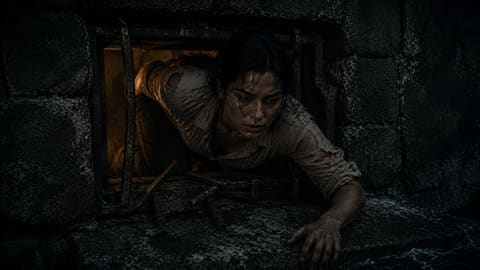
Dak’s hand appeared in the gap. She gripped it. The second bar came faster — the masonry already fractured, the iron levering out in two pulls. The opening was barely wider than her shoulders.
She went headfirst. Stone caught her shirt at the ribs and held. She twisted. The basalt edge dragged across her side — a hot line from hip to armpit, skin parting. Dak’s hands locked around her wrists and pulled. She was halfway through when the shout came from inside. The cell door — someone rattling it open, lamplight hitting empty floor.
She kicked free. Hit ground. Dak hauled her upright and they ran.
Behind them the harbor office bloomed with light — every window, lanterns swinging, voices converging. She heard her name. She heard boots.
Ten minutes downhill to the cove.
Kae stopped. The wall to her left had no window. Behind it, Vess was breathing through broken ribs in the dark, and the boots were already between her and him.
Dak seized her arm. She ran.